Sunday, 4 September 2016

"Kinky Boots", Adelphi Theatre, London, 29/7/16


Joyous, ebullient, engaging and thoroughly entertaining, "Kinky Boots" is a wondrous musical experience that lifts the spirit and rejuvenates the soul. Based on the film - inspired by a true story - the musical tells the story of Charlie Price who reluctantly takes over the failing family shoe factory in Northampton following his father's death. In London he encounters Lola, a drag queen, who inspires him to reinvent his product to save the factory and its workforce. Along the way Lola and Charlie discover love and acceptance and overcome prejudice and fatherly expectation.


The score by Cyndi Lauper may not be the most musically complex but it perfectly suits the tone of the show and is a major element in the uplifting power of the show. Harvey Fierstein's book follows the original movie quite closely, adapting the plot well for the stage. Though the plot details are streamlined somewhat this is all to the benefit of the show's focus: Charlie and Lola and their relationship. Only in such a musical could the detail omitted be acceptable and yet the story remain so very clear. This is, of course, due in part to the director and choreographer, Jerry Mitchell, who works the stage really well, supported by a set design that looks perfect and costumes that light up the stage.


The cast are nothing short of excellent and one must feel a tad sorry for Killian Donnelly who plays 'Charlie' as his role - and perfect acting - is naturally overshadowed by Matt Henry's 'Lola', a dynamic force of nature if ever there were one. Together the partnership is a dream and the contrast between parts is perfectly attuned and each presents a three-dimensional character who elicits a strong response from the audience. The supporting roles are equally as charged and Lola's 'Angels', the drag queens who support her, are beyond entertaining and their use throughout the show is brilliant.


"Kinky Boots" is a truly uplifting production and a show with a message that, while not exactly subtle, does not overpower the show in any negative aspect. In a turbulent world "Kinky Boots" is a pure joy and exactly the entertainment needed to remind us how wonderful people can really be.

Thursday, 25 August 2016

"Rehearsal For Murder", 22/8/16, Theatre Royal Glasgow

Review written for Backstage Pass:

http://www.backstagepass.biz/2016/08/theatre-review-rehearsal-for-murder.html


Playwright Alex Dennison (Alex Ferns) is mourning the loss of his leading lady - and fiance - Monica Welles (Susie Amy), who apparently committed suicide following her West End stage debut. A year later the cast and crew re-assemble at the same theatre to read his new play - a mystery echoing the events of a year before. The cast soon realise that the scenes eerily resemble encounters they may or may not have had with Monica and it becomes apparent that Alex believes that one of the persons present is, in fact, guilty of her murder.
Originally a television film written by Richard Levinson and William Link, creators of "Columbo" and "Murder, She Wrote", this adaptation by David Rogers is the first presentation of the Classic Thriller Theatre Company which replaces the successful Agatha Christie Theatre Company.

The adaptation is well constructed with some witty lines but there are some clunky elements - none more so than the clichéd Welsh assistant (Georgia Neville) who becomes quite a distraction because of the unsteady accent - and the play is a bit of a slow starter but soon picks up. There are a few over-the-top moments in the second act but Roy Marsden's direction is generally simple and clean and his use of theatrical devices, including his handling of the intrusion of the past into the present, is entirely appropriate as is the set and costume design by Julie Godfrey.  Dan Samson's sound design is a little wanting and the occasional use of dull, obvious, movie-of-the-week music is uninspired. The lighting by Doug Kuhrt is atmospheric and used efficiently even if it does leave the occasional actor in semi-darkness.
For the most part each cast member has a decent part to play, although some are more successful than others with some of the weaker elements, including a variety in the quality of vocal projection, highlighted against the stronger. Alex Ferns is strong and dominant as the playwright out for truth and he has hardy support from the charismatic Mark Wynter and the firm Ben Nealon amongst others as the actors in his play. Susie Amy as the deceased movie star has an appropriate aloofness and beauty whilst Anita Harris brings a class and glamour entirely suited to producer Bella Lamb.

A solid, sturdy whodunit with a clever structure and intriguing twists this production keeps the audience guessing and is a worthy follow up to the Agatha Christie fare and a secure beginning for the Classic Thriller Theatre Company.

Monday, 15 August 2016

"The Rocky Horror Show" Glasgow King's Theatre, 8/8/16

Written for Backstage Pass:

http://www.backstagepass.biz/2016/08/theatre-review-rocky-horror-show-kings.html


The original cult rock 'n' roll musical returns to Glasgow! Although, perhaps, the term 'cult' is used erroneously these days as "The Rocky Horror Show" (or "Richard O'Brien's Rocky Horror Show" as it is advertised these days) has long been part of the theatrical mainstream since it's premiere at the Royal Court Theatre in the early 1970s. 
This current production is, in effect, a revival of the 40th anniversary tour once again directed by Christopher Luscombe and it is an exuberant and vivacious party for all present.  

A B-movie sci-fi/horror homage, the plot follows clean-cut "Brad" and "Janet" as they encounter the hedonistic alien "Dr. Frank-N-Furter" and his cohorts from the galaxy of "Transylvania" and - depending on your point of view - their descent into darkness and/or their liberation from society's constrictions.
This is actually the second incarnation of "Rocky Horror" that Luscombe has directed: his first version appeared in 2006 and was a more theatrically pleasing and inventive production, utilising dimensional staging and even shadow-puppetry,  than this current version which, first seen in 2013, returns to a broader, more concert-like feel and presentation, prevalent throughout the late 1990s, complete with the use of hand mics and cut-out sets which blur the musical's roots as a musical play (albeit a unique one). 

Luscombe's direction remains witty and vibrant as does the choreography by Nathan M Wright which, of course, features the "Time-Warp". Beyond the occasional cardboard cut-out-like set the production design is top notch and colourful; the iconic costumes, as ever by Sue Blane, still pop out like works of art (albeit very sleek ones); the lighting (by Nick Richings) is dynamic and the band (visible above the stage) is equally as strong.  
And that is the biggest flaw in this otherwise fine production - it's too polished and flashy; too knowing. Indeed, the original productions had an edge and feel to them redolent of being thrown together; a rawness that invigorated the show and its audience and which seemed more appropriate to Richard O'Brien's B-movie dialogue and simple, catchy songs with their clever, witty lyrics. Whilst there is no lack of energy here the production certainly lacks something of what made those original productions so original and fresh and it is, perhaps, inevitable that this should become so in a musical that has been as popular as this one for the best part of half a decade. But that is not to detract from the sheer joy and fun that this production produces, be it from cast or audience.

The cast are led by Liam Tamne as "Frank-N-Furter" in a performance that dares to vary from the more usual paint-by-numbers Tim Curry knock-off and which is, for the most part, an exciting success;  Tamne is certainly the naughtiest "Frank" to grace the stage in many a year. Diana Vickers holds her own as "Janet" whilstRichard Meek creates a more rounded "Brad" than one would think possible; he is engaging to watch and his beautiful voice is one of the best in the production. "Rocky Horror" veteran Kristian Lavercombe is ever reliable as "Riff Raff" with his dynamic vocal ability setting the bar for his fellow "Transylvanians", his energy never dropping for a moment. The same can be said of Kay Murphy as "Magenta" and Sophie Linder-Lee as "Columbia" who both make the most of their limited material. Dominic Anderson's "Rocky" is certainly a feast for the eyes and his comedic talents are clearly displayed here. Paul Cattermole is a more hesitant "Dr. Scott" than most but his "Eddie" is a more full-on affair and Norman Pace fares excellently as the "Narrator" where he is quick and funny, handling his audience expertly.

"The Rocky Horror Show" remains a thoroughly engaging experience and it remains one of the most striking examples of the relationship between the performer and their audience, being one of the more successful shows in bringing a non-traditional theatre-goer into the auditorium. The messages "Rocky Horror" portrays are still as important as ever and it's evident that "Rocky" will endure and in whatever re-incarnation it chooses. 

Saturday, 6 August 2016

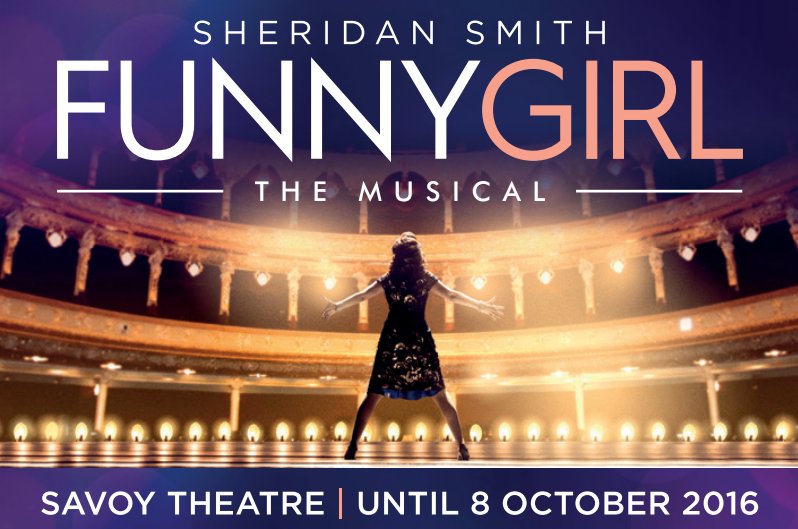
"Funny Girl", Savoy Theatre, London, 28/7/16


Second time around.

I'll admit, given my first experience with Sheridan Smith in the role, I was kind of hoping her understudy, Natasha J Barnes, would be on (she now shares the role with Smith who, for some reason, is unable to perform eight shows a week) especially given the raves she received when she filled in for a few months when Smith took leave (in fact the reviews were better for Barnes than Smith). As it happened, Smith was on. I had my fingers crossed she would, at least, get through the first act but otherwise left expectations at the door. As it turned out she completed the entire show. Just.


This production transferred from the Menier Chocolate Factory and was reworked in certain regards when it reached the West End stage - the design was enlarged and dance sequences were expanded. With a revised book by Harvey Fierstein (original by Isobel Lennart), Music by Jule Styne and lyrics by Bob Merrill the musical contains some iconic numbers including 'People' and 'Don't Rain On My Parade' and originally starred Barbra Streisand who has been intrinsically linked with the show ever since. It is, perhaps, because of this fact that a revival has yet to appear on Broadway and has only now materialised in the West End of London. Smith's profile and following was clearly enough to give the producers confidence in transferring to the West End (a confidence that must have been shaken following recent events) and, if nothing else, this production does indicate that "Funny Girl" need not rely on Streisand to sell it. It does, however, require a comedic actress with strong vocal gifts to lead the production. More on that later.

The production itself is relatively simple - not surprising given where it started - and doesn't have a massive chorus or orchestra. The simple production design by Michael Pavelka has some lovely elements including mirrors which are used evocatively. My only real qualm is with the backdrop which shows the auditorium of what appears to be a grand opera house, rather than a Broadway theatre fitting for the Zeigfield Follies back in the day. Travelators are used to effect throughout but this is the extent of the most technical aspects of the show (which makes the previous cancellation due to 'technical difficulties' harder to believe). Mark Henderson's unobtrusive lighting fits easily into the simplicity of the production as do the costumes of Matthew Wright.
Lynne Page's choreography is likewise relatively simple yet effective and the direction by Michael Mayer serves the show well, especially his use of Pavelka's mirrors which reflect the idea that the story is actually told in flashback.
The orchestra, which actually contains a string section, may be a touch thin on the ground but the sound they produce is quite impressive and the musical direction is confident, although 'Who Are You Now' (which in this production becomes an entirely pointless duet between 'Fanny' and 'Nick') and 'The Music That Makes Me Dance' are performed at such a tempo as to make their emotional content weak and ineffective.


The company are really excellent and contain numerous stand-out performances, from Marilyn Cutts, Valda Aviks and Gay Soper as 'Mrs. Brice' and her friends to Bruce Montague as 'Florenz Zeigfeld' who is both commanding and tender. But Joel Montague as 'Eddie Ryan' is a revelation. He dances and sings strongly, creating a character of real dimension and one the audience can empathise with. Darius Campbell as 'Nick Arnstein' cuts a striking and dashing figure and his vocals are as strong as he is still. It is this stillness which creates a dramatic contrast to the hyper-active 'Fanny Brice' of Sheridan Smith. Indeed, Smith's 'Fanny' is quite chaotic and one is not always convinced this is part of the performance. There are several occasions throughout the show where it seems Smith is veering on the edge and this sense of uncertainty and danger is one that can make an audience uneasy. Based on what I witnessed of her performance previously, this time around she is certainly more assured and confident, her diction clearer and her voice stronger (and more in tune), but she still relies too heavily on one or two vocal tricks and facial expressions, which actually become predictable throughout the show, to really make her performance entirely believable. She is indeed funny at times, even affecting, but there are too many points in the production where she is seemingly almost out of control. Her voice is not strong enough to handle the demanding score and in the bigger numbers it was very clear when Smith was gearing up to hit a note and I wonder why some of the numbers' keys were not lowered (this would certainly have aided Smith greatly). Whilst she managed to hit virtually all the notes, the sound that came out often sounded shrill, strained and thin and I found myself thinking of many a mediocre karaoke singer singing those same songs in bars around the world. The fact that Smith visibly broke character to celebrate her getting through 'People' is also not a great indicator. With all that said, Smith can be a moving actress and she does often find little moments to really show her talent. It's just a shame this is inconsistent.


But the show works, even if the revised book is not as successful as one would hope (the second act appears to need more work whilst the first wouldn't be harmed by a little trimming), and this production shows that the ghost of Streisand need not deter producers and directors from staging the show more often. It does show that a strong lead is required, however, and that lead need not be a famous name.
The show has announced a UK tour which is to commence in the new year and I only hope that the producers take these facts into consideration when casting 'Fanny'. Given the reviews she received, they could do worse than cast Natasha J Barnes in the role. At least then I'd get to see her in the part.

Tuesday, 31 May 2016

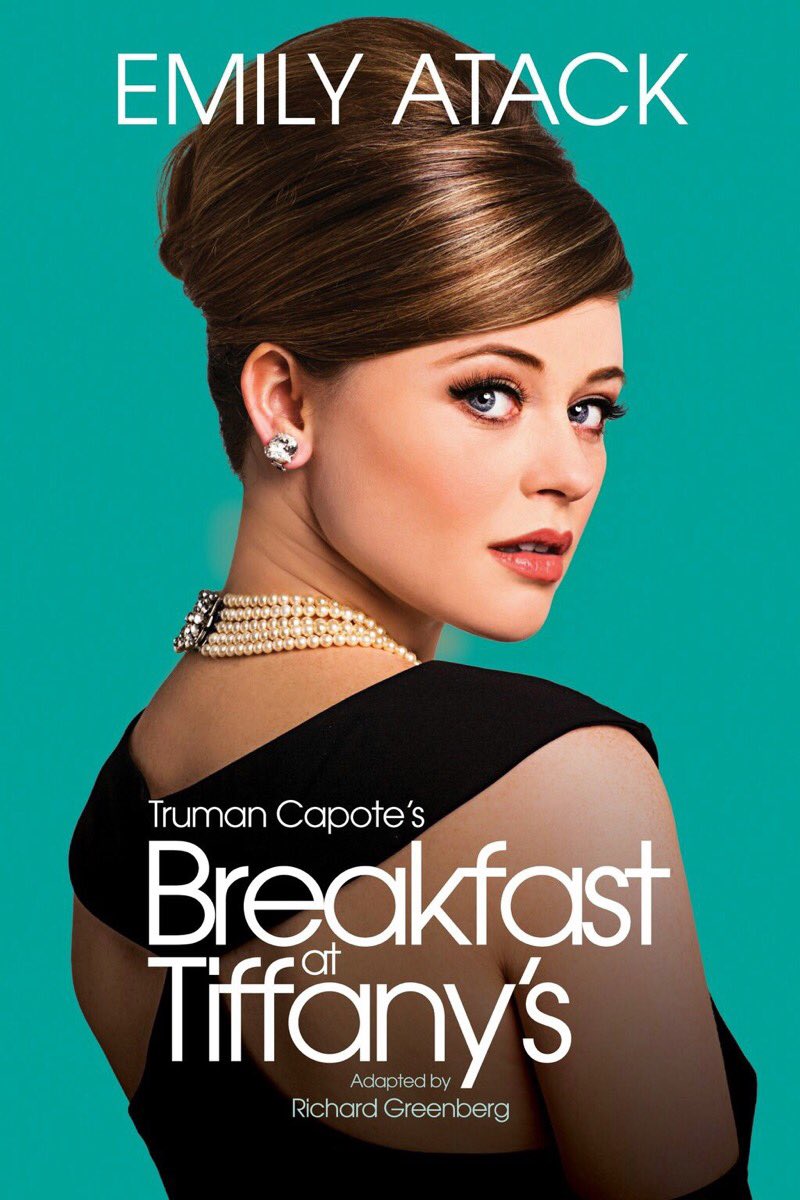
"Breakfast At Tiffany's", Glasgow Theatre Royal, 26/5/16


Richard Greenberg's adaptation of Truman Capote's famous novella was first seen on Broadway in 2013 and was the second attempt at a staging by director Sean Mathias (the first, in London's West End in 2009, was written by Samuel Adamson) and neither production proved to be what one would consider a success, leading others to speculate that perhaps the story is one of those which doesn't translate adequately to the stage. This new production by the Curve Theatre, Leicester, may have the doubters proclaiming they were correct although, in reality, there are glimmers throughout that illustrate the true potential of the play.


Greenberg's script is clunky in places and really could do with some trimming although the devices he utilises work well, including much of the narration by the character 'Fred'; such a device could have come across as stale but director Nikolai Foster is adept at making it anything but. 
Foster is a director who works with his designers to create a fluidity onstage that is pleasing to the eye and the lighting and set design are positive additions to the production and raise the standard of the entire production.

The cast are uniformly quite excellent, including Matt Barber as 'Fred', with the only exception, sadly, being the actress playing the major role of 'Holly Golightly'. It may be an unfortunate side-effect of casting several actresses in the role for the duration of the tour, but Emily Atack, whilst attractive to look at, lacks the depth required for the pivotal role and she comes over as somewhat under-rehearsed, lacking in confidence and it feels she may be overwhelmed with the demands of the role. Her performance is two-dimensional with not enough variety to give it the edge required. She does, though, offer glimpses of her potential in the role but she fails to take full advantage when these crop up. Her singing voice is delicate and sometimes fragile, not inappropriate to the character, but the fact that three songs are plonked almost randomly throughout the script means they serve no purpose whatsoever, save to placate the audience expectation that they'll hear the famous 'Moon River' which was composed for the film adaptation of the novella.


It should be said that Greenberg's adaptation is based on the book rather than the film and so the play is more layered and multi-faceted creating a grittier, darker plot within a grimmer New York than that portrayed in the movie. This, ultimately, creates a more interesting drama and, given a tighter reworking by the author and a more competent lead, shows this particular adaptation has some real potential.

Thursday, 12 May 2016

"Joseph And The Amazing Technicolor Dreamcoat", Glasgow King's Theatre, 10/5/16

Written for Backstage Pass:

http://www.backstagepass.biz/2016/05/theatre-review-joseph-and-amazing.html


Vibrant, vivacious and joyous Joseph and the Amazing Technicolor Dreamcoat explodes onto the Glasgow stage in Bill Kenwright's perennial touring production of Andrew Lloyd Webber and Tim Rice's timeless musical, their first to ever be publicly performed.
Since its premiere on the stage of Colet Court School in 1968 as a 20 minute cantata "Joseph ..." has been expanded over the years to a full blown musical entertainment; its inherent simplicity, catchy pastiche-laden score, humorous lyrics and the familiarity of one of the most famous stories of the Old Testament all coalesce to create one of the most popular pieces of musical theatre ever. In fact there can be few people left in the western world who is not aware of "Joseph ..." or who has not heard at least one of its musical numbers.

Tim Rice's lyrical talents are on full show in this production as is Lloyd Webber's inherent melodic knack and Kenwright directs a production that is full of life and wit, almost perfectly complimenting the musical material. "Joseph ..." is certainly Kenwright's most directorially triumphant production, no doubt aided by Henry Metcalfe's choreography which is equally in tune with the comedic, ebullient nature of the show and full of vigour and energy.
There are some transitions that threaten to halt the show's flow and which should be worked into the production proper whilst there is also some stage business that is little more than filler - as if to beef up the running time of a show which is, in reality, still a relatively short one.
The same could be said of some musical moments where sequences are slowed down unnecessarily causing the rhythm of the show to drag and, where lyrics are sung, potentially damaging some of the many lyrical witticisms of Rice.
Sean Cavanagh's design is ostensibly the same that has been used over several decades but it is, in its present incarnation, a more detailed and colourful affair and the lighting  of Nick Richings is perfectly attuned to the rich, bright production.
The sound design of Dan Samson and the musical direction of Kelvin Towse is also to be complimented and it is unfortunate that Kenwright, again, fails to credit the orchestra given the importance that musicians play in a musical but this oversight is easily corrected and will hopefully be rectified in the near future.

Bill Kenwright has assembled a truly top-notch cast for this present incarnation of his most famous production; replete with a high energy, diverse cast who sing and move with gusto. Emiliano Stamatakis makes his UK premiere in the Elvis-inspired role of "Pharaoh" and he is an attractive, engaging performer with plenty of sexual charm appropriate to the part. Lucy Kay, as the "Narrator", stuns with a powerful voice, showcasing a belt worthy of the most hardened of Broadway performers. She imbues the role with the warmth and allure necessary as the story-teller of the evening.
Of all the roles in musical theatre Joseph is not the most demanding of acting roles but it is a difficult role to pull off nonetheless as what little he is given has to convey so much; Joseph starts out as an arrogant, vain, pain-in-the-proverbial but he must still be able to attract sympathy from his audience. He must be seen to learn from his experiences and to come to feel empathy and compassion for others. In Joe McElderry, Kenwright has found someone who has a natural charm and likeability matched with a winning personality and affability that is quite perfect for the part. With his naturally pleasing smile and his truly strong vocals McElderry is a performer who engages the audience from the off and his powerful voice belies his stature. This has to be one of the most strongly cast companies in any production at present.

Powerful, radiant, energetic and vividly arresting Joseph and the Amazing Technicolor Dreamcoat defies all expectations in a production that rejuvenates a stalwart of the touring scene thanks to a superb cast and a creative team who appear to defy the temptation to rest on their laurels. A wonderfully glorious production!

"Tell Me On A Sunday", Edinburgh Playhouse, 9/5/16

Andrew Lloyd Webber and Don Black's 1980 song cycle about the unfortunate love life of an English girl in New York is making the rounds in a sporadic tour of one-night-only appearances featuring Jodie Prenger as the sole onstage performer. 
"Tell Me On A Sunday" was originally an album and television special featuring Marti Webb as the unnamed woman and was then expanded and coupled together to create "Song and Dance", billed as a "concert for the theatre", which premiered in London's West End in 1982. With each successive performer small changes were made until the piece made it to Broadway in 1985 in a substantially re-written version which originally starred Bernadette Peters in the role which came to be named "Emma"; a name the current creative team have adopted for this current tour, although the name is never mentioned onstage.


This current production is primarily based on the original 1980 album albeit with some of the additions made for the 1982 "Song and Dance" West End production together with a couple of the songs written for the 2003 West End production of "Tell Me On A Sunday" which was especially expanded as a stand-alone piece for performer Denise Van Outen.
Returning the play to its (nearly) original format allows its original simplicity and emotion-focused content to shine. The additional songs used are carefully chosen to compliment the original material and the creative team wisely dispensed with some of the more questionable additions made for the 2003 version. It also returns the show to its original time period of the early 1980s.
The four piece band produces a perfectly adequate and lovely sound although the 1980s orchestration of electronic piano etc., a sound I distinctly think of as "1980s", was missed - but only slightly.

The setting by David Woodhead and lighting by Howard Hudson are simple with the band tucked behind an array of New York skyline buildings (including the Empire State and World Trade buildings, together with the Statue of Liberty) which reminded me of the original "Song and Dance" design, though here they were three dimensional constructions rather than prints on flats.
This simple design allows all focus to shine on Prenger and she doesn't fail to deliver. Prenger's voice handles the material almost effortlessly and she even shows a softer, gentler, voice that one doesn't expect from someone known for her strong, belt voice. She manages to act convincingly throughout, consistently focusing on the invisible people her character reacts to and interacts with. Along the way the audience never doubt her actions or intentions and have no difficulty in making out what is happening onstage (a potential hazard for a one person show).
The direction by Paul Foster is relatively simple, as one should expect, but it is clean and clear as is the musical direction and the only thing that niggles is a few transitions between songs, where "Emma" leaves the stage only to reappear a few moments later in a new costume, which almost become dead space. Thankfully Prenger is always in character and never allows the audience to drop their attention.

With a running time of little over an hour and given the choice not to incorporate most of the additional material to increase the running length, we are given a small question and answer session with Prenger in the second half of the evening (following an interval, of course) where she also sings  a handful of songs, including a duet with her standby, Jodie Beth Meyer, a most generous act which allows the audience to hear another lovely voice onstage. Prenger also gives us a chance to hear "Unexpected Song", which was a later addition to "Song and Dance" and which does not appear as part of this production of "Tell Me On A Sunday" - frankly a bit of an error on the creatives' part, which Prenger pulls off with aplomb.

Given the rather hap-hazard nature of this tour it was still a little surprising that such a small and intimate production should appear at the cavernous Edinburgh Playhouse where it could easily be lost. That the audience was only half-full speaks volume about the choice of theatre and the choice to put it on on a Monday evening which is not usually the most popular of nights.
That said this is still a surprisingly strong production and a most pleasant way to spend an evening so if you get the chance do go see it.

Friday, 6 May 2016

"Save The Last Dance For Me", Glasgow King's Theatre, 3/5/16


Written for Backstage Pass:

http://www.backstagepass.biz/2016/05/theatre-review-save-last-dance-for-me.html


Following the success of the jukebox musical Dreamboats and Petticoats, Bill Kenwright presents another musical utilising the hit songs of a bygone era. Save The Last Dance For Me has a book by famed television writers Laurence Marks and Maurice Gran and centres around two young sisters in the early 60s who embark on a holiday to Lowestoft, without their parents, encountering potential romance along the way. When the younger sister falls for a black soldier stationed at the local US Army base trouble begins to brew.

As a stage musical Save The Last Dance For Me comes across as something of a dual aspect show: There is the concert element with the US band playing and singing on the club stage, which works well, and there is the play element where the plot is grafted between the songs (of which there are far too many), albeit clumsily.

The book by Marks and Gran has some wonderfully funny lines and moments but it is drastically under-developed and the mixed-race relationship subject is treated weakly. It's a subject that needs detailed and thorough work, even in a comedy, and consequence and repercussion are sadly missing from the paper-thin plot. The fact that the numerous songs often have only the slightest relationship to the action or plot and do not evolve out of the spoken dialogue naturally makes for a rather clunky musical construction and one ultimately wonders if there is much point to the plot's existence to begin with.
Bill Kenwright directs the production with a rather uninspired hand and his staging is often surprisingly static and stodgy. The piece could have been 
better structured under a more competent director and the same could be said of the choreography of Bill Deamer whose work seems surprisingly limited here.
The set design by Mark Bailey (who also designed the pleasant costumes) is primarily that of the US base bar and that particular set highlights the onstage band excellently. Most other aspects of the set, however, seem almost to be an afterthought, like much else about this production. The sound design also needs more work because, whilst the band sounds quite brilliant, the vocals are often lost in the bass-heavy sound produced. 

The entire cast make the most of the limited material they are given and there are some truly great voices onstage including that of Lola Saunders as elder sister, Jennifer. Saunders really impresses as the more vivacious sister and she is someone to look out for. Jason Denton's charming Curtis is blessed with a smooth voice and an attractive presence whilst Alan Howell's Carlo is endearing and humorous. Marie, the younger sister, is a sweet and tender role and Elizabeth Carter plays and sings it to near-perfection. 
It's quite stirring that the cast can impress as well as they do with the restricted dialogue they have but there is no-one onstage who gives less than 100% whether singing or not. Former Blue boy-band member Antony Costa, as Milton, is also a pleasing presence and his voice is showcased well. 
The band, who also serve as members of the cast, are wonderful and should be worked into the script more.

It would appear that nostalgia concerts, where original artists (or not) perform a set list of songs from a particular era, are no longer enough and that songs must now serve a function in a larger context instigating the creation of a plot around them. The jukebox musical format has given the public some great success stories (Mamma Mia being perhaps most prominent) and some less successful (Viva Forever, one of the most unfortunate) and Save The Last Dance For Me is evidently one of those that the audience clearly enjoy (they are actively encouraged to sing along) yet it is ultimately a dramatically unsuccessful musical. The plot holds an interesting, yet undeveloped, idea and the songs used do not really serve to move the action forward and there are far too many of them. 

A reworked, song-trimmed, version may be a more intriguing and satisfying production but in its present state Save The Last Dance For Me is a case of go for the songs not for the plot.